
Blimey. OK, GHM attempts to step up to the plate for this one…
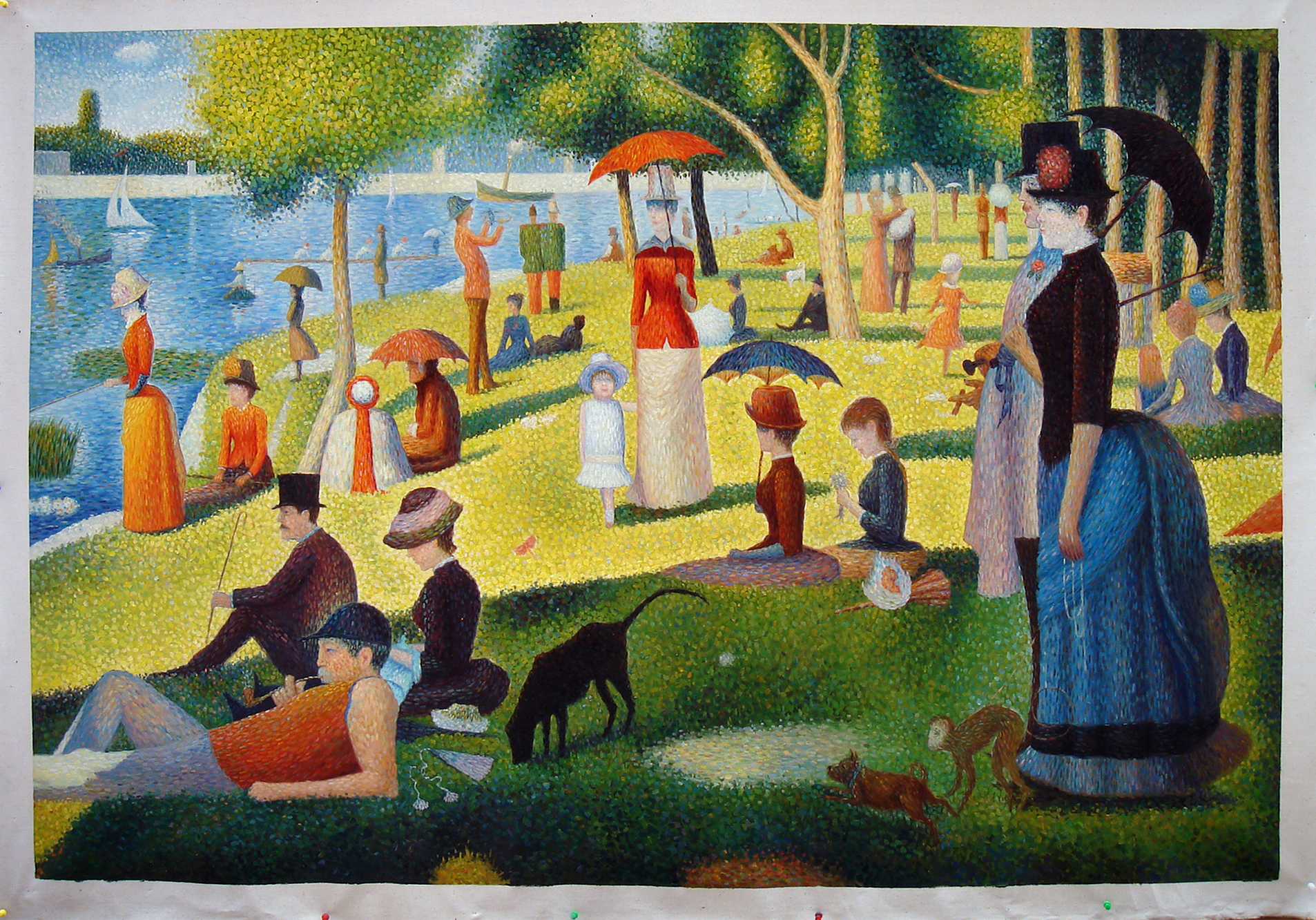
This is Sondheim’s 1984 collaboration with James Lapine. The first act is about Georges Seurat in 1884 painting “A Sunday Afternoon on the Island of La Grande Jatte” – i.e. this – http://www.fabulousmasterpieces.co.uk/userimages/seurat.JPG. The second act is set in 1984 and shows us Seurat’s great-grandson, George, struggling with his own art, in this case a series of giant light-and-colour machines.
I saw the Applause production of this, although unusually for Applause it was kinda fully-staged, with most if not all the cast off-book and certainly moving around the stage in a fairly planned way. (For newcomers to GHM: Applause is a Vancouver group which puts on a number of rare / unloved / forgotten musicals each year, but usually they’re concerts with very limited movement and costuming.) At the time Sarah and I kinda scratched our heads, concluded that Sondheim Is Difficult, and went home. Sarah has since been plagued by songs from this show, which are usually crammed full of random collections of very fast notes, the accompanist’s favourite kind ;-)
But I listened to it twice yesterday, and, somewhat reluctantly, thought very hard about it, and now bring you the following thoughts:
Seurat invented pointillism, which is the technique of painting a picture using many small coloured dots to create the visual effect. The modern very-small-photo-montage-used-to-make-a-giant-image thing that you see on posters is vaguely related to it. And, for that matter, television does the same thing. If you look at these pictures at a long range, they look perfectly ‘normal’; close up you can start to see the dots, and by the time you get very close you start to wonder how on earth this has the effect it does, because clearly this isn’t any part of ‘reality’ – reality, we think, is made up of continuous elements, continuous lengths of materials and fabric and flesh, of brushstrokes if you like (it’s no coincidence that computer modelling tools talk about ‘brushes’ when they mean ‘objects’) – and yet here was Seurat saying that you could simulate it with dots. Critics at the time labelled it ‘pointillism’ as an insult, and didn’t like it.
So Sondheim has taken Seurat’s struggles, including his difficulties with his mistress Dot who ends up leaving him for Louis the baker, and used pointillism as a metaphor for how people are put together and taken apart by their relationships. The Sunday scene which seems so carefully composed in Seurat’s painting is an accidental arrangement of all those characters who are in the park for all their different reasons as Seurat sketches them. Fair enough. He also – and this is where your mileage may start to vary – spends some time developing the idea that art, as the creative act, is at a tangent to other aspects of life, and that artists, in creating things, are only ever fettered by other people’s opinions of their work.
This shows up in the first act as Seurat sings about the attention to detail and the miracle of creation involved in “Finishing The Hat”, and significantly more in the second act, where George faces exactly the opposite problem to Seurat; whereas critical gallery-goers in 1884 don’t like Seurat for being new, people in 1984 are dubious of whether George’s art is new, because now new is what they want. Working on “Chromolume #7” – “Seven? I thought it would be a series of three… maybe four…” – has left George fully aware of the pointillistic needs of building an artistic career brick by brick, dot by dot, only now the points are of data and money, not paint, and the work that’s on display is consequently the artist himself, and not the art.
Seurat tries to get into the head of every character, including the animals, in an attempt to understand their worlds. And even the name of Seurat’s mistress has meaning ;-) For him, the art is a journey into another world to bring back its reality to ours. In painting something, even ‘reality’, decisions must be made, and every single thing which appears on the canvas is a thing which was not there before; every presence and every absence is a creative decision, a work of art, the work of a god. But gods are historically linked quite strongly with worship, and the question is, what happens when people do not worship the creative god? Sponsors and galleries are looking for work which brings them kudos; French audiences in 1884 are looking for beauty and life in their painting. What happens if an artist isn’t delivering on the public’s wants and needs? And, if only one person likes a work of art, isn’t that enough? In fact, does it even need one other person to like it – isn’t it enough that the artist has created it from nothing?
That’s (probably only some of) what this show is saying.
So, the first thing to note is that Sondheim and Lapine has artfully tried to bulletproof their show against criticism. And to an extent have succeeded, in that it contains no particular internal logical holes; if you toss this show into the river of your mind it will either sink like a stone or proudly float, with no half-measures and no slow embarrassed gurgling sound. It makes sense. The question is, is the sense that it makes true and/or correct? Sondheim’s take on that is clearly that it only matters for each individual witnessing the artistic work, and that criticism attempts to autotune other people’s minds to fit your own, thus invalidating your own response. And that response, being personal, should stay personal and within you. In featuring a range of opinions about the art, and showing the prices which Seurat and George willingly pay in order to produce their art, Sondheim is undercutting any charge or slant that Artists Are Good or Artists Are Bad: Artists simply Are.
Sondheim also features a lot of humour, but it’s very Sondheimian humour, by which I mean that you will laugh when he says, and at no other time. There are some extremely heart-on-sleeve moments where we’re clearly meant to be overwhelmed by the pathos of the situation. Unfortunately, one of these is the central song “Finishing The Hat”, and the problem, unfortunately, is that the word ‘hat’ is very funny. Here are some of the lyrics, deliberately quoted out of context for comedy value:
Coming from the hat,
Studying the hat,
Entering the world of the hat,
Reaching through the world of the hat
Like a window,
Back to this one from that
Finishing a hat…
Starting on a hat..
Finishing a hat…
Look, I made a hat…
Where there never was a hat
OK OK, I’m being so unfair doing that, but we got the giggles while listening to the song at the time, and it’s still funny. It’s not fair because yes, it’s true, on Seurat’s scale and arguably in any form of art, finishing a hat is just as impressive a feat of creation as finishing a tree or a dress or any other word which doesn’t sound funny. Sondheim is saying that this isn’t just any hat, this is the proto-hat, the ur-hat, the Original Hat, yielding another variation in our world thanks to an artist who is deliberately sacrificing his life to find a new way to express ‘Hat’. You may have heard the quote about how the first poet who wrote “lips of coral” was a Surrealist, but the second poet who wrote it was a hack. It’s not about this hat, it’s about This Hat, a hat which you have never seen before. It’s very powerful, y’know.
But it’s still the word ‘hat’. snicker
And that’s probably the biggest problem with this show. In attempting to strictly control every aspect of the story, including our anticipated response to it, Sondheim is attempting to vault the abyss of reception theory, which says that it’s not up to him, it’s up to us. This is something he had another stab at in “Passion”, where you’re supposed to take on board his reading of the story (“true love might be terrifying but it’s still true”) as opposed to the obvious and time-saving reading (“this woman is clinically insane, lock her up”). He doesn’t go quite as overboard here, so whereas “Passion” is a bit of a waste of time, this show just about makes its point without getting too lost in the murk. But he still wants you to laugh when he says this is funny, and feel moved when he says this is moving, and I think he goes too far in doing so, ironically enough removing our ability to have a genuine personal reaction in a show which is supposedly all about asserting the importance and the right of everyone to do exactly that.
Musically, well, Sondheim’s not going to pass up an opportunity to find out what pointillism in music sounds like, is he? It’s more obvious in the piano reductions. The songs are often very fast, and yes, funny: the first act opens with Dot bemoaning the heat as she poses for Seurat, and the second act, excellently, opens with everyone still frozen in the poses they were in at the end of the first when Seurat locks down his painting; now they’re in the painting, hanging on the gallery wall, locked forever in time, and it’s still very hot. (It’s a bit creepy, actually, a bit “Sapphire And Steel”.)
So how does Random Panda score “Sunday In The Park With George”? With difficulty, obviously. It would be mildly crass to assign a number and walk off whistling, which is why I’ve gone into this much detail to try to show that I’ve thought hard about it. In the end I think I see what he’s getting at, and I sort of agree, and I could second-guess myself till the cows come home about whether saying “but this isn’t a perfect world, so here’s my score” is just another way of pouring acid on the putative foundations of that perfect world. But on the other hand, I’m scoring based on what the show actually is, not on what it would be. Obviously in a perfect world everyone’s show would be perfect and say what they wanted it to say and do what they want it to do. But this isn’t a perfect world, and I think “Sunday In The Park With George” is a difficult and confusing show which needs a lot of investment in order for you to extract a meaning and conclusion, which you might then still not agree with.
Nevertheless, Random Panda awards “Sunday In the Park With George” ten out of ten pieces of bamboo. I don’t write this much and think this hard about most shows (OK, I do sometimes write this much, when a lengthy kicking and evisceration is called for, but I don’t have to think too hard about those ones). But I wouldn’t want you to think that I’m being bullied into this score. I didn’t enjoy all of the songs, laugh at all the jokes, cry at any of the sad bits, or think “Ooo, I want to sing that”. This is a show that needs to exist, as a reference point if nothing else, but that you don’t necessarily need to see – top score notwithstanding. This is a response, not a recommendation. Still, as I say, there’s not much else around that sounds like this and makes its points with such vulnerability. For all Sondheim’s prickliness and critically defensive layering, this is him telling whoever wants to listen that he loves them, and that as a result he’s ready and willing to be stabbed in the heart. And as always, if you don’t want to risk stabbing your lover in the heart, you just shouldn’t fall in love in the first place.
(originally posted 2009)

 Gil Hates Everything
Leave a comment